Sunday, July 10, 2016

divide and conquer

Around 2003 I was involved in the education program at the King County Jail on 5th Ave as an assistant teacher for GED and ESL classes through Americorps for over a year. The GED graduation numbers there had recently improved when the educators started planning on the inmates coming back to jail after they were released, because this allowed them to focus on getting them up to speed on one or two sections of the GED at a time. Most of the time, if an inmate didn't have a GED, if they were in jail, you could safely bet they would be back.

And what was the point of them getting a GED anyways if they weren't going to be able to get into college, because their crimes would have likely disqualified them from getting financial aid? Were they even guilty? Did it really matter if they were just going to plea bargain for time served anyways so they could get back to their families and jobs?
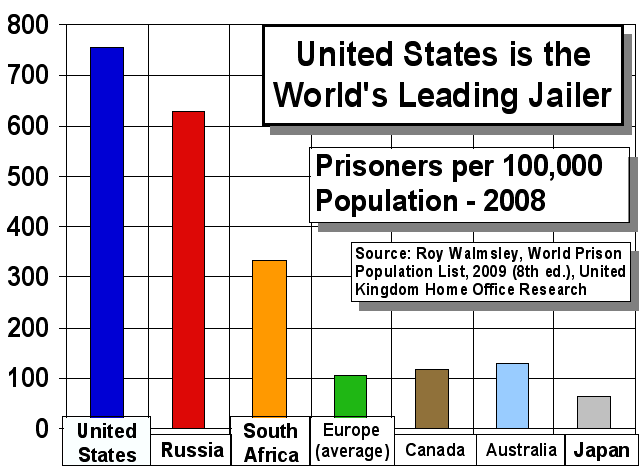

When the worlds supposed icon of freedom (USA) has the world's highest incarceration rate, you know there's a problem. When did slavery end in the USA? What do you call it when you lock someone up so they can't leave and the only employment options they have pay them far less than minimum wage? What do you call it when minorities are disproportionately represented in that "justice" system? Slavery, as in actual pre-civil-war race-oriented slavery.

How do people go to jail and/or prison? Who puts them there? Who keeps them there? I am not talking about who is responsible, I am talking about who literally does the hands on dirty work: the Police.

"Give me liberty or give me death" is a USA core morality. We believe it is OK to kill to gain or maintain our freedom. If a female was forcibly locked into a strangers basement and used as a sex slave, and she used lethal force to escape, we would elevate this female to the status of an exalted hero for her accomplishment.

Say what you want about rape culture in the USA, but there is clearly one place where rape is considered a virtue in the USA: prison. We often racistly declare that justice has been served with the following statement: "Well, he's got a big black room mate named Buba now." In other words getting prison-raped is part of the justice we assign to criminals. How is trying to put a man in prison different from trying to lock up a female in your rape dungeon?

2nd Amendment gun rights advocates constantly suggest we need armed militias to keep our government in check. If completely innocent blacks are being frequently killed or incarcerated by police, and an organized group of blacks retaliate with firearms against police, is this not the ultimate example of using firearms to keep our government in check?

In 2009 I was the Security Supervisor for Seattle City Hall. I worked with police to get video footage of an off duty security guard getting cut in half by an out of state party bus. In the dim light it looked like the bus cut a bag of red apples in half as the red parts rolled down the hill towards Seattle City Hall. An officer who had responded to the scene expressed to me that "when I first saw the uniform, I thought to myself 'oh no!' But then I looked down at the cloth badge, and realized it was only a security guard, and said to myself 'thank God!'"

He didn't blink. He didn't look at me and say to himself "oh wait, this guy is working for a private security agency." It was a simple and natural fact to this detective that police lives were far more valuable than the lives of security guards. A police officer hadn't been the victim here, sympathy for security officers was the farthest thing from this detective's mind. Other police in the room had not corrected him, but only nodded and sighed in relief as well. I knew at that time the SPD was heading towards dark places.

Word on the street is the culprit was discovered, but that no criminal charges were ever pressed. Would the result have been the same if that had been an off duty police officer instead? If security guards are not cop-like enough for cops to consider significant, can we really expect cops to highly value the lives of the average black person?

Most of the cops I have interacted with have been excellent people and problem solvers, and I was very glad they were there to help at that time. However most public health safety risks don't kill everyone every day. If a small-yet-significant daily risk persists, it becomes a dangerous health risk over the course of years and decades. I suspect these police shootings are more closely related to the violence in our society created by the proliferation of handguns, than it is to the issue of racism specifically.


If our police need to have guns, those guns should stay in the police cars, not be a standard part of the police uniform. They should not spend all this time in the academy training to draw light weight firepower. Instead they should have sniper riffles, assault riffles, and shot guns available for when they need firepower, but not bring that firepower with them into most situations. Instead of spending all that time in the academy learning to fast draw like a sheriff in an old western movie, they should instead master the art of the baton, and live by it:

Besides replacing the side arm with a baton keeping the assault riffle in the trunk, I would imitate the United Kingdom's policing style in other ways. In the UK deaths at the hands of the police are far less common, and the incarceration rate is much lower:

It takes special kinds of people to be cops. They have to be willing to risk their lives, serve the community, believe in obeying rules, have a high level of mental and physical competence, and be good problem solvers. What do you call it when those people are set apart from the rest of us, given a mandate to incarcerate, and teach them to use lethal force against us as a high priority as part of their training? Divide and conquer:

Monday, June 6, 2016

Methadone Clinics: Higher Power's Answer


I will not confirm or deny if I have ever worked for methadone clinics, but I will say that through college and other environments I have developed many close friends who work at methadone clinics, and that my education and experience makes my opinion about them far more informed than most who have opinions on this subject.


Why do methadone clinics work? The following is my opinion, but I am sure there are many researchers who agree with me on some of my theory here:
  1. As outpatient programs, they allow patients to change their lives outside of treatment, so that they can alter the social network they depend on to survive. This takes time. In all cases it takes chemical dependency counseling. In other cases group therapy or classes will help. In some cases mental health counseling is required. It takes a lot more than the 30 days that most inpatient programs provide (and of course patients can't change their social network locked up in an inpatient program or jail.)
  2. Methadone has special properties that make it ideal for addiction recovery. It has a long half-life, meaning that it stays in the patient's system longer than other opiates. They only need to take this medicine once per day in most cases, and then even if they do miss a day most patients will not have severe withdrawal symptoms for 48 hours. This means that the LIFESTYLE of methadone is very different from opiate abuse, because methadone isn't a drug they use to get high, it is a medication they take that helps the patient with a specific medical condition they have (opiate dependency.)
  3. Used as prescribed by a methadone clinic, methadone does not give an instant high, it acts very slowly to prevent withdrawal, but too slowly to satisfy the need to have instant gratification for a drug abuse habit.
  4. The dirty secret people want to avoid talking about is though the withdrawal symptoms from other opiates and methadone is about the same, withdrawal from methadone lasts about ten times longer. So on one hand the patient has a carrot: when they do as the counselors say, they continue to get methadone which massively cuts down on their opiate abuse bill. On the other hand, if they don't make a serious effort to getting into recovery, the methadone clinic has a stick: the dreaded methadone detox.
  5. Methadone clinics are an act of social engineering. When the methadone clinic reaches this far and deep into someone personal biology and social network, just changing things this deeply for one patient can have a huge impact on that patient's workplace, family, friends, and so on, for the better. Now multiply that effect by how many patients that clinic has as the years go by. The end result is the hopeless dregs of humanity are recycled into pillars of the community. It's this big picture effect that makes methadone clinics transform entire communities. Opiate abuse is a public health hazard, and a methadone clinic is a public health solution.
But isn't this just replacing one drug for another? No, because as I have stated above, methadone is quite unlike other opiates.

Isn't methadone just another pain medication, and thus isn't a methadone clinic just another pain clinic? Methadone clinics have always discouraged the prescription of methadone by people not working at methadone clinics. For the reasons mentioned above (2-4,) it is an incredibly bad medication for managing pain. Pain clinics may be compared to methadone clinics once they take the following precautions that methadone clinics also take:
  1. Mandatory monthly random drug testing of patients.
  2. Taking biometrics to be certain the incoming patient is experiencing physical withdrawal before they can become a patient at the methadone clinic.
  3. Mandatory chemical dependency counseling and education for the patient.
Don't methadone clinic patients frequently relapse? All chemical dependency patients frequently relapse. Relapse is a learning process where patients figure out what does NOT work for their recovery. Some think it is an important part of developing the skills they need to get into full recovery. 

You have heard of nicotine gum, patches, vapers, etc. that people use as nicotine replacement therapy to stop smoking. That is how methadone clinics use methadone (in addition to mandatory counseling,) except for instead of quitting smoking they are quitting opiate abuse:
  1. Just because someone on nicotine gum slips and smokes a cigarette doesn't mean they should give up on the gum. However they will need to learn from their slip up and make changes accordingly if they are to quit smoking. Same thing goes for getting into recovery long term, slip ups are likely to happen, but they are exactly how the patient - with counseling - can figure out how to quit.
  2. As people try to quit smoking with nicotine replacement, they smoke a lot less cigarettes, and that is very good for them. When patients use their medicine prescribed by a methadone clinic, they use a lot less street drugs, which means less fatal overdoses, less criminal activity, less shared needles, and so on.
  3. If a person permanently goes on to nicotine gum, and can't ever kick the gum habit, the health consequences of this nicotine gum addiction compared to continued smoking are laughably inconsequential. Likewise, if a person becomes a life long patient to a methadone clinic, the health consequences of this are laughable in the face of the health consequences of continued opiate abuse.
How can I say that methadone clinics are the most effective treatment against chemical dependency in general when they are focused only on opiate addiction? Remember the part were the methadone clinic does random drug testing on patients: they test for all the big name street drugs, AND alcohol, AND some stuff you probably haven't heard of before. The chemical dependency counseling MANDATED by methadone clinics addresses all chemical dependency addiction, not only opiates. This is because drug use is a compound problem where most drug abusers do not only use one drug. To understand this you need to know how they classify drugs to see how their use is connected:
  1. Hallucinogenics: these make you see the world differently. The most common legal one is tobacco, and the most popular one is marijuana. It also includes magic mushrooms, LSD, PCP, XTC and so on. These are the drugs people take to "go on a trip," like a smoker going out for a smoke break to escape reality for a few moments. Compared to uppers and downers, hallucinogenics are not very addictive.
  2. Uppers: these give you more energy. The most common legal one is Coffee (caffeine), and the most popular one is crystal meth. It also includes Ritalin, bath salts and cocaine. When people use coffee at work to get a burst of energy, they are using an upper. Uppers are very addictive.
  3. Downers: they help you relax and chill out. The most common legal one is alcohol, and the most popular one is pharmaceutical pain pills. It also includes opium, heroine, and anti-anxiety medications. Downers are even more addictive than uppers, and can have fatal withdrawal symptoms, unlike hallucinogenics and uppers.
Typically what you will find is that when someone is abusing drugs, they are using them in the same way that regular people might use tobacco, alcohol and coffee. When a normal worker might go out for a smoke break, your drug abuser may instead get completely baked with a joint. When a normal person might reach for a cup of coffee, a drug abuser might shoot up some crystal meth. 

Now this last part of the story is critical: when a normal person might shake off the negative consequences of being strung out on coffee and cigarettes all day at work - which is to say that so they can go home and sleep soundly they first stop at the bar for a drink - a drug user may instead shoot up some black tar heroine. The following statement has become cliche for soccer moms across the USA "How can I get the kids ready for school, go to work, come home, clean, help them with their homework, take them to scouts or sports, feed them dinner and get them to bed, how can I do all that unless I use crystal meth? And if I use crystal meth, how can I get to sleep if I don't use heroine?"

You found a needle in the park, and you are concerned your community might have a crystal meth or heroine problem? Sorry friends, your community has a crystal meth AND a heroine problem, they are two sides of the same coin. The only side of the upper/downer cycle who's withdrawals can actually kill you is the downers. If you can treat the downer problem, you knock out a leg of a 2 legged problem. Furthermore, methadone clinics will exploit this strongest of the two legs to knock out the other leg through counseling the patients are forced to take seriously with both a stick and a carrot.

12 steps has worked for a lot of people, shouldn't we be turning to our higher power instead? If there is a God, certainly methadone clinics must be miracles. Many methadone clinic counselors encourage their patients to attend 12 step meetings, 12 steps can still be a very valuable part of recovery as long as they don't let the devil fuel their pride with the lie that says "replacement therapy is just trading one drug for another."

Is methadone associated with fatal overdoses? Again I am endorsing methadone clinics here, methadone is not in and of itself an addiction curing wonder drug. To understand how overdoses work, you don't have to read through very many news articles before you realize that they happen through taking multiple types of downers together. Methadone, anti-anxiety medication, and alcohol are not very likely to fatally overdose the user individually by themselves, but combine any two of them together and you have a very real overdose risk. If combining all three becomes a habit, fatal overdose actually becomes likely. This part of why methadone clinics do so much testing on their patients biology. To be clear, methadone clinics dramatically reduce the risk of fatal overdose for opiate abusers.

Considering that 1) methadone has more prolonged withdrawal symptoms, and considering that 2) methadone clinics bring many drug abusers together in one place where they can more easily reinforce each other's bad habits (as with 12 step programs,) do methadone clinics actually make it harder for drug abusers to quit? Look at these assumptions:
  1. Once a person is using ONLY methadone, they are no longer in a cycle of getting a short term rush at the expense of long term well being, as described above. Their social network has changed adapted to their new lifestyle of no longer abusing prescription and street drugs. At that point, getting off methadone at a methadone clinic is a simple matter of the patient working with the professionals there to slowly detox from the methadone at the patient's own pace, on the patient's own terms. This makes relapse much less likely than quitting cold turkey. It is certainly much "easier" and likely than quitting cold turkey. (And over the years I have in fact met many "pillars of the community" who were "methadone clinic graduates.")
  2. Bringing a community of drug abusers together in one place to get into recovery also helps spread good habits related to quitting drug abuse. For example, patients at methadone clinics must attend mandatory counseling sessions. If a patient is waiting at a bus stop with another patient, the patients can reinforce the good habit of attending these counseling sessions by relating positive experiences to each other which they have had with their individual counselors.
More importantly, by bringing a cross section of the drug abusing community in one place, there relationships can be studied up close by the methadone clinic. The professionals there start to understand how the entire drug abusing community works together. This information is very useful for those methadone clinic professionals systematically taking apart that community by helping individual patients move beyond that community. (Good luck getting that opportunity to study the active drug abusing community with a wall standing between chemical dependency professionals and the active drug abusing community, like what you have in a 30 day inpatient program or jail.)

Are other types of drug abuse treatment such as 12 steps or inpatient programs trivial? All established forms of drug abuse treatment are helpful. Certainly there are some drug abusers who have not stepped over the line into opiate abuse, and those drug abusers are by definition beyond the reach of methadone clinics. Any drug abuse treatment program that can help a drug abuser kick their habit before they get into sustained opiate abuse is very beneficial. However these programs need to be very fast to recommend methadone clinics to drug abusers who are discovered to have a significant opiate abuse problem, else those programs become an enabling part of those drug abusers avoidance of methadone clinics!

Will drug abusers learn better if we let them suffer the consequences of their actions? Three important points here:
  1. First, many people get into opiate abuse because their doctors over prescribed pain medication, through no fault of the patient. That is a tragedy, not a "learning experience," we do not want people to learn to avoid doctors.
  2. Let's apply this logic to other medical conditions. Should we quit treating smoking related illness because most smokers were not forced at gunpoint to start smoking? Should we quit treating obesity related diseases because their is some chance that the conditions could have be prevented through better self control? This leads us to my 3rd point:
  3. "Just let them die" is not a mature way to approach this topic. If that is your joke, note that not only is it a point of dark humor, it is point of inappropriate humor in the face of the Hippocratic Oath.
Don't most heroine users quit using before they fatally overdose? Methadone clinics effectiveness is scientifically established. Contrast that to this quaint notion of "some heroine users stop on their own." Downers can replace each other, and many alcoholics are heroine users and vice versa. I am sure many heroine users avoid fatal withdrawal by replacing opiate abuse with alcohol abuse, leading to death from internal organ failure or drunk driving accidents. BUT THE BEST WAY TO CURE THESE ALCOHOLICS WAS PROBABLY TO GET THEM IN A METHADONE CLINIC WHEN THEY WERE USING HEROINE!

Will methadone clinics cause more problems in our community than they solve? No, it dramatically reduces crime in the community, while also socially re-engineering the community to be less drug abusing, as I have described above. The source of rumors to the contrary is a blight on the 12 step community and an example of how misinformation from the 12 step community is harming addicts. With adequate investment in Public Safety and Community Relations staff, I have seen crime near neighbors of one methadone clinic actually reduced during the hours the methadone clinic was open!


Tuesday, May 24, 2016

Happiness = Slack + Graditude

Do not ever burden another person with your happiness. All the love songs you have ever heard were lies. No one can complete you, make you content, or be everything to you. You only had a mommy once, and that relationship started falling apart on day one, and no one is ever going to be that for you again. If you try to make a lover be that, then you are being a big baby.

The formula for happiness is to take the freedom in your life you need (Slack,) and to appreciate what you have even though you need more (gratitude.) Take some responsibility for your own happiness and pursue Slack and gratitude with vigor.

Gratitude is the ultimate virtue. Most of the do-nots from the 10 commandments, 7 deadly sins, and Buddhism (think "attachment") are the opposite of Gratitude. Though we are dependent on perishable goods (food which rots, clothes that wear out, and technology that becomes outdated,) and thus will ALWAYS need more, contentment will be far more easily gained if we take the time to appreciate that which we already have.

Consider the Don Draper character of the TV show Mad Men. He manages to ruin marriage after marriage by cheating on his various wives with women who are not even as attractive as the ones he's already married to (and in addition wrecks his ideal life style were he could live with his children.) Because he fails to appreciate what is right there in front of him, he seeks more than he should and destroys that which he has, which was already better than what he sought. This is an excellent example of a failure to appreciate; less gratitude, less happiness.

Slack is an obscure term, but something which I define specifically: the time you have to do the things you want to do. This is something life will take from you completely if you do not protect it. I am an activist when it comes to Slack, as I have a mandate with my day job employer that my maximum amount of time I can work as a regularly scheduled work week is 24 hours. I feel guilty about this because it really should only be 21 hours:


You only live once. There are things that you can only do while you are young, and it is a lot more of the things you want to do than you realize. Live life like it matters, enjoy it while you actually can. Don't wait until hospice to spend time with your loved ones. As Orbital once quoted Satan as saying "The thing about regret is: it is better to regret something you HAVE done, than to regret something you HAVE NOT done."

Slack gives you time for Gratitude, and Gratitude helps you prioritize Slack, in a positive feedback loop. However they are also safety checks for each other:
  • Gratitude is a safetly belt for Slack in that if Slack goes too far family and personal freedom from prison can be compromised - gratitude helps you prioritize how your Slack is used. 
  • Slack is a safety belt for gratitude in that it prevents you from thinking "Oh, everything is just fine in my life, if I just keep working for retirement I'll be able to do everything I want to do when I finally get on SSI at age 70."
Of course you would have to exercise extreme frugality to get more Slack than you have now. That kind of frugality can only be exercised with high levels of gratitude. Maybe what you want to do is spend all day plumping up in a cubical, and if so good for you, life will be very rewarding for you.

Thursday, May 12, 2016

Phil Gribbin


Phil Gribbin died today at age 42, some time in the AM. When a friend stopped by to go work out at the local YMCA, he found Phil had a fatal heart attack. This was not entirely unexpected as he had been diagnosed with congestive heart failure a few years ago.

He was the loyalest friend I have ever heard of. He loved Heavy Metal, good food, and the company of good people. He died a virgin, a status he considered an accomplishment. I have three things to share that his friends would want to know about:
  1. Spooky stuff about his death.
  2. Thanks to specific people who made his last year of life enjoyable.
  3. His life's work and legacy.
Spooky

Last night after a Tres Espadas meeting, out of the blue Phil asked me very directly "what is it all for?" I told him about my personal martial arts goals. He said "don't get me wrong, I am not suicidal. But I live for training, for Tres Espadas, and out of pure tenacity to spite those who don't appreciate me being alive." Though he had been able to spar in 2015, he hadn't been able to spar much in 2016 because of health reasons. And he said that just last night, and he doesn't normally talk like that.

Last night he had requested me to provide Root-beer Floats for desert, but I didn't have time to go out and get the ingredients. This is not something we have often. I just coincidentally happened to have the ingredients on hand in the house at the time. He had no way of knowing that I had those ingredients, because I had purchased them the day before without his knowledge. I meant to mention to him last night how strange it was I just happened to have the Root beer and Ice Cream at the time he had requested it (he assumed I had found a way to go the store to buy it,) but I never did get around to telling him. This is a bizarre coincidence considering the fact this would be his last meal with friends.

Phil trained my kids in weapon sparring. Today, several hours before we had heard Phil had passed away (and possibly very soon after he passed away,) my 5 year old said: "I don't like Earth. Sooner or later, you have to die. Earth is mean!" He went on like that for a few minutes, out of the blue, for no apparent reason. Then tonight I found out Phil died at around the time my 5 yr old started complaining about the brutality of the world and the final nature of death. Again, the 5 year old never talks like that.

Thanks

If you are reading this you probably know Phil had a hard life with many disappointments and struggles. However he stated on numerous occasions that since he had returned from Atlanta a year or two ago, he had been having the best time of his life. As he had been one of my best friends for decades, I can testify to that. This was very much due to very specific people taking time and other resources to help him improve his life:
  • Dave Welch found him today, and was his fitness partner at the YMCA.
  • Other Welches allowed him to stay on their property, preventing him from becoming homeless.
  • Greg Mapes helped Phil get a bus, so that Phil could start converting it to an RV (as living in an RV was one of Phil's life goals.) Greg also helped Phil in many other ways that were very meaningful to Phil.
  • Bear Star was someone Phil looked up to for advice on how to live life, and had helped him on his bus project.
  • His star pupils who took an interest in Tres Espadas, Haran, Randall & Daniel, gave Phil hope for the future. He mentioned you guys last night as reasons why he was still alive.
It means a lot to me that Phil's life ended happily, and thank you very much to all who helped make that happen.

Legacy

After a lifetime of exposure to martial arts, Phil, I and a few others founded a full contact weapon sparring club called Tres Espadas. Phil was the driving force behind it, as it was his original idea and he put more into it than anyone else. Phil was a huge Dog Brothers fan. We helped promote the first Annual North West Warrior Tipon Tipon, and we even spectated at the second one:

Phil told us many times that he considered Tres Espadas to be his legacy. What he was trying to do was promote full contact weapon martial arts, which would spar continuously without frequent stopping. When Tres Espadas first started forming it wasn't even clear how that would be possible with the safety equipment available at the time. However he constantly researched better equipment and teaching methods to develop what we call Tres Espadas today:

Even after he had been diagnosed with congestive heart failure, last year he was still able to hold his own against more fit opponents. This is how he would want to be remembered:

Updates

Update #1 - Here is his official obituary out of a local paper:

Update #2 - here is the video of the first Tres Espadas free sparring after Phil's passing. They continue to have meetings at 4:30 PM on Wednesdays in Bremerton:


Update #3 - On Phil's Facebook Memorial page, a childhood church friend of Phil inquired about what was said at the funeral, to which I replied:
...I did a more elaborate version of my blog post. Before me Mike Gribbin spoke on stories about how Phil had sacrificed for others. After me Mike Anderson spoke about you guys getting kicked out of Scout Camp from Phil throwing knives, you guys getting in fights in Sunday school and being told you'll never go on Missions (lulz he's stake president now.) He also did the requisite preaching on the plan of Salvation that is required for all LDS funerals. Mike used doctrine to explain common LDS beliefs about how the dead interact with the living.
Here is the outside (top) and inside (bottom) of the program from Phil's memorial:
Here is a picture from Ty Mangum (childhood church friend, probably the one in front center with white t-shirt) that shows Phil (far right with glasses) and Mike Anderson in a blue coat in the middle. Also of note is closest to Phil is recently deceased Brian Ellermeier:


Update # 4 - this photo showed up on the day of Phil's Memorial from David Waters. It's Phil doing Kung Fu within five years of 1999, around the time Phil was the sparring partner for Margaret:

This is the last Picture with Phil and David waters in it, in the early years of Tres Espadas. The five men in this picture were close friends in High School:

Friday, April 15, 2016

Theodore Roosevelt Fencing: Single Stick

President Theodore Roosevelt was a very well rounded martial artist, best known for his boxing and wrestling which he had studied since he was a student at Harvard. However he was also known for the indulging in a type of fencing called "Single Stick" which he practiced with his friend Leonard Wood (Governor General of the Philippines.)  Single stick is a type of western fencing where a cudgel is used instead of a foil, so that the practitioners can hit any target on the body and can do so with full contact impact (as you would expect from boxing) while the weapon remains solid and hefty:

Some contend that Roosevelt & Wood were actually practicing Canne De Combat from France rather than "proper English Single Stick". However, I insist this hardly matters, because if you take Single Stick as practiced in the video above, and make it continuous without stop and go point-counting, you end up with more athletic, flowing and energetic techniques (see also the difference between Karate "point fighting" and Kickboxing), so that no doubt Canne De Combat is simply French Single Stick:


Single Stick was used as training in  the US military during the Spanish American War which Roosevelt fought in as a founder of the "Rough Riders." Single Stick was in the Olympics of 1904, and continued to have competitions held within the UK's military until the 1950's. In other words, for most people who practiced fencing for self-defense or to learn to use a sword for actual combat, fencing was a type of stick fighting all the way through the first part of the 1900's. In traditional ancient Filipino Martial Arts the stick is still used to prepare for sword fighting up to the present day. Before you write off my controversial correlation here, consider that the primary form of sparring for the martial art of Gatka from India is clearly also a type of Single Stick:


But a swordsman is not complete with fencing skills alone. One lucky punch can drop an attacker, but the vast majority of the time it takes many more punches. Likewise a lucky slash or stab from a bladed weapon can end a fight, but from a self-defense perspective it is unwise to expect that it will. The odds that someone can and will get past your sword into close range grappling are good. As Roosevelt got older he became more and more interested in what he called "Jujitsu", the grappling martial art of the Samurai which was developed specifically for grappling encounters while sword fighting. Roosevelt was actually studying Judo, which at that time was much more like what Brazilian Jiu-Jitsu is today:

Thanks primarily to MMA and Filipino Martial Arts (but also thanks to numerous other martial arts) today in the USA this type of training is widely available; you don't have to go to Harvard and then join the military to pick up single stick, boxing, wrestling or jujitsu. The best of the best of these types of martial artists meet regularly at events called "gatherings" (translated from the word "Tipon" in Tagalog.) The most famous gatherings are the "Dog Brothers Gatherings" in California and Europe, but there are local Gatherings such as the Northwest Warrior Tipon-Tipon in the Seattle area and the various "Beat The Crap Out of Cancer" gatherings in Canada (notice the Gatka fighters doing Teddy-style Single Stick at 12 minutes 30 seconds):


Friday, April 1, 2016

3D Faith

WARNING: This is an overtly religious post, though it does have implications for anyone interested in the general subject of religion.

As I see it, there are 3 dimensions to "faith in Christ," and probably faith in other God/s, though certainly the first two dimensions must apply to most religions:
  1. Acceptance
  2. Accordance
  3. Action
Thus someone's over all volume of faith in Christ could be measured by multiplying their Acceptance by their Accordance by their Action.

Acceptance

By Acceptance I mean how much do you believe that the God/s you are thinking of (Jesus or otherwise) exists. But I hereby suggest that there is a massive range of depth in Acceptance. For example:
  • A secular humanist declaring "I don't think Jesus ever existed, but I do think he exists as an idea as a set of teachings that can help people become better people" is a legitimate depth of Acceptance of Jesus. 
  • A less shallow depth of Acceptance would be "I think Jesus was a historical figure and a great teacher, but I don't think there was anything supernatural about him."
  • A slightly deeper yet level of Acceptance would be "I really like the story of Jesus, and I want to believe there was something divine about him."
This continues to progress into slightly deeper and deeper levels of faith in Christ, all the way down to the hard-core follower believing in miracles. 

Accordance

However, just because you accept a God/s existence, doesn't mean that you agree with (or are in "Accordance" with) that God/s agenda. In James 2 v 19, as part of the debate on Grace vs. Works, James quips "You believe that there is one God. Good! Even the demons believe that—and shudder." In other words, the devils who openly oppose God/s have a powerful Acceptance, but they fundamentally disagree with the God/s agenda.

Consider this classic from Blutengel:

The story goes that a girl was rejected by her Christian neighbors, got no answers from praying to God, but had a different experience when praying to the Devil instead for the help she needed, which resulted in her falling in love with him and finding a far better level of happiness. This is a great example of how someone could easily decide to disagree the God/s agenda.

Does punishing those who disagree with you, really sound like a good idea to you? It's easy not to be on board with the God/s agenda. Jonah and the Whale in the Old Testament provides a clear example of a follower of the God/s having a problem with the God/s agenda, but generally any time any biblical prophet is chastised by God/s we see this same issue at hand.

Do you agree with the God/s actions, instructions, or agenda? To what degree you do agree with all that is what I call Accordance.

Action

Our actions reveal our true belief more than anything else. I look both ways (action) before crossing the street, because deep down inside I truly believe that I could be hit by a car if I don't look both ways.

Christians add that God/s actually showed up and demonstrated the best way to be mortal in the flesh. In so far as Jesus was actually born, lived, and died, he left an example for how we should behave. He left an example of how to follow his own teachings.

When Christians think "Jesus doesn't happen to be standing right here right now, but I can feel his love, so it is my responsibility to be Jesus right here in this situation, right now" they are realizing their need for Action.  Certainly this is what the Jesus archetype suggests in Mathew 22 v 37-39 "‘Love the Lord your God with all your heart and with all your soul and with all your mind.’ This is the first and greatest commandment. And the second is like it: ‘Love your neighbor as yourself.’"

When we see some major Christian figure doing truly things which Jesus would do if he was here, such as Mother Teresa taking care of the poor, or Pope Francis openly attacking income inequality, there we see examples of Action. 

There are Jews and Muslims who believe that Jesus was a great teacher who taught the will of God, that as Jesus taught we should be nice to each other and not let our own egos get in the way of our own happiness. In so far as they allow this limited Acceptance and greater Accordance lead to Christ-like Action, they have a greater over all volume of Faith in Christ than do Christians with high levels of Acceptance and moderate levels of Accordance, yet very little Action to demonstrate faith in Christ. Consider this speech at Christian establishment Liberty University, by Bearnie Sanders, a known Jew:


Product

"Christians" who embrace and take Action on unkind ideals like what Ayn Rand preached, can not be said to have very much faith in Christ at all. Ted Cruz quotes Ayn Rand here in the act of objecting to medical coverage for the poor:

Ted "Son of the Devil" Cruz can have profound Acceptance and Accordance with Jesus, but if his Action is polar opposite of what Jesus would do, Ted's volume of his faith equals nothing at best. As the Apostle James said (2 v 18) on this topic, "Show me your faith without deeds, and I will show you my faith by my deeds."

In fact, the teachings Ayn Rand have been codified in the opposite of Christianity, Satanism. Just because you call your god "Jesus" does not mean your Jesus is my Jesus. If you read the New Testament and walk away with Ayn Rand as your Accordance, and your Action is based on her words, the religion you are embracing in practice is Satanism:
Quite frankly I know many secular humanists who are far better "Christians" and have vastly superior "Faith in Christ" than Ted Cruz does.

Monday, March 21, 2016

To Hell With Chromebooks

Update - Announced at Google I/O 2016, Google is officially going after Windows on the desktop, with a Chromebook update that will allow newer Chromebooks to run Android Apps. In other words, holiday season 2016 Chromebooks should be able to run Android Apps: http://www.networkworld.com/article/3073473/android/google-i-o-2016-every-android-app-really-is-coming-to-chrome.html
However, the following condemnation still applies to all Chromebooks too old for the new update (and to all Chromebooks until such time as this Google I/O promise materializes):

I hereby offer my complete and absolute condemnation of the Chrome Operating System (Chrome OS, and the Chromebooks which are all contaminated by the Chrome OS.) I have tried and come close to making Chromebooks work for me for years now. The only thing they are good for is as stationary web browser terminals for users who are not gamers and who do not do web development: senior citizens.

There are two ways to use a Chromebook, 1st is how it is shipped, exactly as it is out of the box. 2nd is in "developer mode." In developer mode there are numerous hacks you can do to improve the Chromebook that typically fix the Chromebook by allowing you to run operating systems that are not Chrome OS. However, once your Chromebook is in developer mode, there will always be a self-destruct screen, that every time the Chromebook is turned on, will provide simple instructions presented as direct emergency orders - just two key strokes - that result in the Chromebook being completely wiped, deleting all data and operating systems off the Chromebook and reinstalling Chrome OS. All the work you put into installing the other operating systems - and all the work you haven't backed up yet that you could do with that alternative operating system - gone forever.

But aren't gamers or web developers skilled enough to avoid pressing two keys that destroy their workstations? That question presents a very specific lifestyle - one without children, with only highly computer literate friends, one without significant others - only making sense if you have completely sacrificed your social life and family life for your career. Quite frankly it reflects very poorly on Google corporate culture. Thanks to the self-destruct screen me and my friends have lost dozens of hours of work on Chromebooks. "Developer mode" is a non-starter, worse-than-Microsoft/Windows crippling crapware.

But if I was a Real Man, wouldn't I be able to perform all my gaming and web development needs through the browser, on the cloud? There are two problems with this sentiment: 1st the assumption of universal wireless data access, and 2nd the crapware nature of Chrome OS.

Even in the Seattle Metropolitan area there is not complete 3-G or 4-G data coverage geographically. There is nothing even remotely like universal WiFi. Unless you are at a coffee shop, library or home, insofar as internet access is required to make Chorme OS useful, your Chromebook is a brick. Again this assumption of universal wireless access suggests a very insular, privileged culture at Google.

However the real crux of the problem is that the Chrome OS is complete trash even with internet access. Nevermind the fact that Google could have had Chrome OS running Android apps long ago but chose not to, you can't even get the Unity 3D engine to run in the web browser, making the Chrome browser on Chrome OS far less functional for grade school age children than the Chrome browser on Mac, Windows, or Linux. The same is true for flash games in general.

But it gets so much worse. Want to FTP something to your web server or save an image at 150 DPI for use in a PDF? Good luck with that. You might be able to find an expensive 3rd party service that will allow you access to their servers that will allow them to do it for you, but quite frankly if I wanted to spend a handful of cash for every piece of software I need to use, I would just get a Mac. Nothing but condemnation is justified for this being a "feature" on a supposedly budget computer.

This blog is named after Google's failure to support their projects after suckering developers and authors to sink many of their own hours into the projects personally (see "Google Knol.") However Chrome OS and Chromebooks are a project they have allowed to go on far too long - it should have never reached the point where anyone was actually selling Chromebooks in the first place. The fact that Chrome OS doesn't run Android apps, its crippled to the point of not allowing FTP or Unity 3D in the browser, and that the developer mode attacks developers, Chromebooks are a complete betrayal of trust on the part of Google to its customers.