I am a casual user of Linux, and this is about Linux from the perspective of a consumer advocate. If you want to just cut to the chase, I strongly recommend Mint Linux for most casual consumers. (Don't get me wrong, this could change, but Mint has been king now for close to a decade.)
The first thing you need to know about Linux is that it is an operating system. An operating system is the software that comes already installed on a device when you get it, which allows that device to work. Most phones use "Android" as an operating system, most computers use "Windows" as an operating system, and Apple has other operating systems for iPhones and Macs.
Most of the time when people use Linux it is on a computer that would normally run Windows. In fact most computers that run Linux originally came with Windows on them. The main reasons to use Linux instead of Windows are:
Linux is free. If you want to update to a new version of Windows, it's going to cost you, and it's not going to be very convenient. Linux has numerous alternatives to this.
Linux is more secure. No, it's not because Linux is less common, it's because Linux is designed to be more secure. Linux users generally don't have to worry about spyware and viruses!
Linux is open source. You can always find out what Linux is doing, because the code is available to everyone. Good luck figuring out what Windows is doing behind closed doors, probably stealing your data and selling it to the highest bidder.
Linux is more stable. When Linux has a problem, it's usually pretty easy to fix. Sometimes with Windows you just can't ever fix the problem because Microsoft isn't hiding their cards close to their chest, they are hiding their cards behind their back.
Linux uses system resources more efficiently - or in other words it makes your computer more powerful. I do not understand why Windows seems to take up 2 gigs of RAM and 32 gigs of hard drive space, but last I checked neither of those things were free, and both things were important for my daily use of my computer.
The next thing you need to understand about Linux is what types of Linux there are. First, Linux is part of a family of operating systems based on an ancient operating system called Unix. Android, Apple's various operating systems, Chrome OS (on Chromebooks,) and Free BSD are all in this same family. But of those, the easiest to install and use on your own computer is by far Linux, which is why Linux is used by do-it-yourself people instead of those other operating systems about 99% of the time.
Now when you get down to Linux specifically, the different kinds of Linux are called "distros" (short for "distributions." If you want to follow the latest news on distros and the horse races on what distros are currently the most used, check out the website "DistroWatch.") What makes this confusing is that most distros are based on other distros. Here are some common distros for other distros to be based on:
Debian: this is the hard core nerd maximum-power version of Linux, very elite.
Red Hat (aka Fedora): this is the corporate business edition type of Linux.
Arch Linux: this is like a lego set where you are given pieces with which to put together a configuration of linux for your computer and situation.
Gentoo: this is super flexible Linux for people who want to micromanage every aspect of their operating system. This is what Chrome OS was based on back when Chrome OS was still Linux.
Ubuntu: this is user-friendly linux meant to be used by the average computer user - I stress "meant" here, because it doesn't always deliver on this promise. Ubuntu was originally based on Debian, but Ubuntu is its own thing now.
And if you are new to Linux, the only distros you should be taking seriously are distros based on Ubuntu, because it is unlikely you will even get other distros up and running. But not all Ubuntu based distros are equal: Ubuntu was the only really user friendly Linux from 2006 to 2011, and then they made a horrible mistake ironically called "Unity" which completely fractured the Ubuntu community. Fortunately one fragment of this community dominated and thrived, and continued Ubuntu's tradition of being user-friendly, and that distro is called "Mint Linux."
Mint Linux is the way to go for most casual users of Linux and Linux newbies, because it is completely focused on being user friendly. It is easy to install, it is easy to use when it gets installed, it looks good, and it is still respectful of your system resources even though it looks good. Mint is the easy linux: it is easy, and it is linux!
It's 2020 and things are changing fast. I wish Chrome OS was a decent operating system I could install the software I need on, I wish Android was a serious challenger to Windows, I wish Google was done working on a new Operating System called Fuchsia that might be better than all of the above some day in the future, and I wish Ubuntu had never done Unity. But we install the operating system that is available to us, not the operating system we wish was available to us, and that operating system is Mint.
And honestly Mint is a fine operating system indeed, I have basically no complaints about it what so ever. The only issues that people might be concerned about are 1) not all Steam games work in Linux, and 2) some business software is Windows-only. However for most laptop and desktop users Mint is a step above all other operating systems:
In 2018 I wrote about encapsulation in martial arts. But the other side to that is martial arts overspecializing in one aspect of training until that training loses relevance. When it comes to self defense in general, understand that studying only unarmed martial arts for self defense is already overspecialization. For comprehensive self defense you also need training in situational awareness, what to do in an active shooter situation, and how to use weapons you have available to defend yourself with.
Another common form of overspecialization in self defense is shooting at the gun range. First, the vast majority of people with a need to defend themselves don't have a gun easily available to them most of the time, if they even own a gun in the first place. Second though practicing at a range is certainly an important aspect of gun training, there are at least 4 other aspects that need to be trained in if firearms are your primary martial art for self defense: deployment, retention, strategy and sparring.
The most encapsulated martial art is probably Boxing - punches only. It is highly effective in self defense because of the efficacy of punching (high power, low risk,) the importance of knowing how to defend against a punch and because of Boxing's footwork. Studying boxing will improve almost anyone's punching, punching defense and footwork.
BUT the downside to this is those are the only martial arts skills you will learn in boxing. Let's say someone said "I want to do MMA, but I want a good foundation first, so I am going to train boxing until I win 10 boxing matches." The problem there is overspecialization: there's a lot of other stuff you need to know for MMA besides boxing!
But MMA itself is limited when it comes to its application to street fighting for self defense. The UFC was originally designed to show the value of grappling to martial arts consumers, and within the first few UFCs fans became convinced that grappling was far more important than striking (until Maurice Smith came along and fixed that for them.) In a one on one confrontation with no weapons, grappling can be more important than striking. The problem is that martial arts consumers don't study martial arts so they can beat up one other person who does not have weapons: martial arts consumer's first and highest concern is being attacked by more than one person or someone with a knife.
Boxing vs. MMA in this context plays out very differently. The issue is that much of the time an MMA fighter is going to want to take the opponent to the ground. The MMA fighter trains to do this until it is a reflex. If you are on the ground with a knife, and you haven't trained to control that knife, you are more vulnerable to getting stabbed than you were on your feet. Strategically being on the ground against multiple attackers is even worse.
Against multiple attackers a Boxer is going to be staying on their feet and dropping people with punches. This is one of the best strategies I know of for both handling someone with a knife and for multiple attackers. Boxing is called "the sweet science of self defense" for very good reasons.
Still MMA is a precious resource for all martial artists, helping them see were their vulnerabilities are as a fighter and making sure they have a well rounded skill set when it comes to unarmed fighting. Where things get complicated is with Jujitsu. Most forms of Jujitsu (Judo, BJJ, Aikido, etc.) have a low emphasis on striking, and most who claim to study some form of Jujitsu don't spar with strikes at all, meaning their maximum skill level for delivering and defending against strikes is minimal. Their plan A most of the time is to go to the ground with the opponent to control them. (Contrast this to say collegiate wrestling, where avoiding the pin and escaping is just as important to winning as pinning - nothing trains you to get on your feet like collegiate wrestling.) Jujitsu gives you all the going-to-the-ground vulnerabilities of MMA, without helping you cover your blind spots the way MMA does.
I found a lot of useful things from Aikido to spar with even though I only trained in it casually for a few years. The problem is that once someone is overly committed to training in Aikido, they invest massive amounts of time into wrist lock technique: for many Aikidoka, wrist locks ARE Aikido. What they don't grasp is 90% of those wrist locks are found in 90% of other traditional martial arts, but only a few of the least-sparring traditional martial arts have deluded themselves into thinking wrist locks are a reliable technique that should be used often.
This is post is a sequel to my earlier 3D Police post, where I pointed out that what the public wants and the public does NOT get is crime prevention. My last post was on bad lefty branding, and "defund the police" is BLM style bad-branding, utterly failing to describe the issue Defund the Police wishes to pursue (more funding for other unspecific services, not the dissolving of police as an institution.) Before we get what I am about to propose, we first need to understand the three categories of organizations that exist and the four types of public safety that exist. The three categories of organizations are:
Government: state funded colleges, police departments, city counsels etc. all paid for by your tax dollars and ultimately controlled by people who depend on your vote to keep their jobs. The bottom line of the government in a democracy is to enforce the collective will of the people.
Businesses: they use money and resources to produce more money and resources. This is where most jobs come from, and it is also where most products and services come from.
Non-Profit-Organizations (NPO): these are essentially charities, typically dependent on grants, donations and/or government funding. These organizations address society's problems: shelters, most chemical dependency treatment, food banks, humane societies, institutions devoted to research, clubs etc.
Keep in mind that certain groups of organizations do not all fall in the same category. A local community college like Seattle Central is a government institution. Antioch University Seattle is an NPO. Argosy (Art Institute of Seattle) was a business. Argosy going out of business is a good example of how not all categories are good for all things, the for-profit colleges are notoriously sketchy and often short lived, a thrift store is what you get when you try to do retail as an NPO, and Government does not produce the best cheese.
Now understand that there are currently 4 main Public Safety roles:
Police: these are the hired guns of the District Attorney, the government's monopoly on violence. Notice they are in the category of government.
Private Security: the professionalism in the security industry has increased drastically over the last few decades, but its obvious to all that business employee "security officers" don't hold the same weight as Police.
Firefighters: that first red ambulance that shows up with the hard core professionals saving your life - those are firefighters. Yes, they have great toys for putting out fires, but their first concern is your immediate physical safety. Notice they do not have the same BLM publicity problem Police have, and notice that Firefighters are also for the most part Government employees.
Paramedics and EMTs of the white ambulance that show up after the red ambulance are basically hospital delivery drivers. Once firefighters stabilize someone in medical duress, the white ambulance staff gets paid a dollar or two above minimum wage to deliver that someone to the hospital. These not-really-firefighters, like the not-really-police above, are business employees.
So where is the NPO public safety staff? Crime prevention is ultimately an education issue. Education is best handled by government and NPOs. Government is already using all the resources they can for crime prevention by providing K-12 education and Police. They should and will do better in the future, but the NPO piece is clearly missing.
The best example I can think of for NPO public safety are the "Downtown Ambassadors" of the "Downtown Seattle Association" NPO. They looks sort of like cops on bikes, except for they don't have guns and are dressed in brighter colors. When they see a problem, rather than panic and make useless complaint after complaint to 911, they actually directly approach the problem. If they see a homeless woman trying to sell herself on the street they do not make an arrest, they instead try to get that homeless woman the help she needs.
And Downtown Ambassadors are now found in Downtowns of major cities all over the USA and Canada. But this is a fairly new and experimental project. What I am proposing here is giving this movement a clear mandate, and expanding it to a much wider range of neighborhoods. What I am proposing is a Neighborhood Safety Team (NST.)
The mandate of a NST is to prevent crime. How to do this best varies from neighborhood to neighborhood, depending on demographics and lifestyles in each neighborhood. In a rural town of 5,000 people, a Neighborhood Safety Teams biggest concern might be alcohol, preventing drunk driving and breaking up teenage parties before the local Sheriff has to be involved. In an intercity neighborhood a Neighborhood Safety Team may be negotiating peace between rival gangs and holding group treatment meetings for people having issues with chemical dependency.
Neighborhood Safety Teams need tremendous autonomy from the Law Enforcement, while simultaneously having tremendous support from Law Enforcement. On one hand Law Enforcement needs to understand that the NST are not extensions of the law; the NST is not there to help the police bring evil doers to justice. On the other hand the police need to understand that if a person on an NST calls for help, that person is in severe danger and has to be a very high priority.
The leader of every Neighborhood Safety Team should be a certified chemical dependency counselor, for the following reasons:
It is likely most NSTs will be involved in getting people into self help meetings like AA and SMART Recovery. NST must be ready and willing to start self help groups from scratch if they need to. Certified chemical dependency counselors can start and run groups.
Much of the crime that needs to be prevented will be drug and alcohol related, and a certified chemical dependency counselor will have some training in understanding this dynamic and what changes need to happen in the neighborhood in order to reduce crime.
There is a special type of legal protection for certified chemical dependency counselors (42 CFR Part 2) that allows those counselors to exercise confidentiality not unlike a lawyer or doctor. Having a certified chemical dependency counselor at the head of a NST helps everyone be clear that the NST is on the side of the neighborhood residents, not the side of the District Attorney.
A NST would be funded through an NPO, depending on what NPOs service that neighborhood. In turn those NPOs can seek grants, donations and/or government funding with witch to support the NST. Because NPOs are always at the mercy of the communities they serve this keeps the NST accountable to their communities. Beyond this local government can decide which NPO in their area the NST will answer to by choosing which NPO they give funding to support the NST.
But an NST doesn't necessarily need government funding. An upper class neighborhood in Florida may have an NST funded through a home owner's association, and that NST might be focused on getting the spoiled grandchildren off of cocaine and helping those grandchildren organize more constructive community activities. A poor rural community may fund an NST through a local church in order to hold meetings for people struggling with methamphetamine and crashing keggers making sure kids are educated on consent and the dangers of alcohol consumption.
But all NSTs will be experts in what things people in their Neighborhood need to do in order to avoid getting in trouble with the law. They will be eagerly explaining these issues to the residents of the neighborhood, educating constantly. In most states a certified chemical dependency counselor needs a two year college degree before they can be certified. But the leader of the team isn't the only specialist that could be helpful on the team. Depending on what the needs are in that neighborhood, other team members with education in law enforcement, sociology, anthropology, education, social work or psychology could be helpful. In some neighborhoods former thugs who have turned their life around could be valuable team members, while in other neighborhoods retired law enforcement might be valued.
You can't expect active duty police to educate instead of incarcerate. You can't expect police to sit down with a drug dealer on the corner and explain to them the dealer could make more money working part time washing dishes with far less risk. You can't expect police to be on call to handle neighborhood disputes in order to prevent violence. You can't have them constantly talking to youth making sure those youth are pursuing edifying activities and learning to stay within the law. You can't expect the police to help reorganize your community to be safer. That's why you need an NST.
I basically don't have faith that law enforcement can change their ways: in the end they are servants of the district attorney, eager to put you in prison for any crime they can trick you into implicating yourself in with their lies and intimidation, weather you are innocent or not. Meanwhile they may beat you bloody or fill you with hot lead for target practice. They are very good at what they do, and they are probably not going to change.
Instead we need a new type of public safety that is focused on crime prevention and education. The NST led by a certified chemical dependency counselor and backed by an appropriate NPO will be able to reach out to the people in your Neighborhood to help them obey they law in the first place so that Law Enforcement does not have to be involved.
I have friends in law enforcement, yet I myself am no fan of law enforcement. Now people are talking about reforming the police. I have some very specific points to make about this:
The legal system itself and its extremes are as much of a danger as the police themselves.
Rodney King lived: a big part of the problem of policing now is their cowboy attitude towards the use of firearms.
We have the technology: there are technical solutions to many of these problems.
We need to move on towards a crime prevention model rather than a law enforcement model.
Look at both sides of this argument. On one hand the police have a dangerous job to deal with dangerous people, and our society can't function without them: at the very least the police do a great job of preventing angry mobs from hanging innocent people. On the other hand the police are an enemy of the people funded by those people's tax dollars, and we should be able to fire them if they are a problem for us, which they are.
First there are lots of laws that overly punish. I am strongly against the legalization of prostitution. However charging the prostitutes with felonies doesn't make any sense at all: what would it take for you to sell your self to questionable men on the street, how desperate would you have to be to do that? Prostitutes are more victim than perpetrator. Prostitution is exactly the sort of crime that should be not a felony, not even a misdemeanor, but a simple infraction. Prostitution should be ticketed to the point were it isn't profitable, that's it. In general if something isn't harming other people or property, it should be an infraction, not a misdemeanor, and most definitely not a felony.
There's massive injustice in our legal system. Seeing so many innocent hard working people "plead guilty for time served" so they could get back to their jobs and families while I was an assistant teacher at the King County Jail is a big part of why I decided to not go into law enforcement myself. The sad fact is that the prison industrial complex is making a lot of profit off of innocent inmates.
But going beyond this, our incarceration system has two other shockingly terrible issues: A. There seems to be no serious attempt at behavior reform in the incarceration system... any chemical dependency treatment for example seems to be shockingly antiquated and ineffective. B. Human rights of prisoners is not taken seriously, be it the fact they aren't allowed to vote, or be it the rape culture in our society that suggests a man being sentenced to a lifetime of rape is some kind of significant justice.
Arrest quotas are a violation of human rights. In fact the opposite would be preferable: each officer could be limited to a maximum number of arrests per month, and police that are able to deescalate without arrests should be awarded. Uniformed patrol officers should be focused on crime prevention, not incarceration.
Second, law enforcement should not have holsters on their uniforms for firearms. They should be able to have any firearm they want, but it should stay in their vehicle until such time as they know for a fact they need it. Taking firearms from police vehicles should automatically sound alarms for backup. Every time this happens a civilian review should take place.
The last thing a police officer should be bringing into a woman's apartment in the middle of the night for a wellness check is a firearm. There is no excuse for a 180 pound police officer to shoot a 90 pound woman with a knife. Once upon a time, police were expected to know how to handle themselves without a firearm, like most men in the past:
Third, police should be allowed to have any non-lethal tech they want to do their job. They should have an abundance of body armor options. If they want to employ nunchucks, two handed batons, pepper spray, tazers, shields, armored military vehicles, whatever, they should have it. One problem with police carrying guns most of the time is it distracts them from making sure they have their nonlethal tech ready to use at the beginning of each shift.
But the other side of this is the police need to all have body cameras. A few bad apples sours the whole barrel, and we already know the police are trained to start telling lies as soon as they arrest us if not sooner. Not having video coverage from body cameras should be grounds for having police testimony thrown out in court!
We should think creatively about using technology to aid law enforcement. In Singapore there are cameras all over the place, preventing most crimes from happening in the first place. With tech in today's world, civilian watch dog groups should be allowed to follow police around with drones to help keep those police honest.
Fourth, and this is most 3D of all these points, is we must move into a new era of crime prevention instead of law enforcement. We tax payers want crime prevented in the first place. A crime is like an unwanted pregnancy, it is a failure of society as a whole when a crime happens.
In our law, ignorance of the law is not an excuse to disobey the law. So then why isn't "Obedience to the Law" a major topic covered in our public education system? Because it's not - not even close. You shouldn't be allowed to have a GED least bit a high school diploma without a sound understanding of how criminal law works, and general strategies for making sure you are obeying the law. Citizens should "know their rights" long before they are arrested, no one should have to learn about the legal system the hard way.
What if the Police were first and foremost focused on preventing crime rather than enforcing the law, what would that really look like? I have painted a sci-fi picture here of nonlethal ninja cops who can shut down trouble without having to kill or arrest most of the time. That isn't realistic now, because what we have now is so opposite of that ideal. We need to have 3D thinking about police reform because the police already fail so badly at what we pay our tax money for them to do: prevent crime!
It's dark times, and you wanna train in good old fashioned knife fighting. But like everyone else, you are broke right now. What can you do? In the land of the most advanced knife fighting technique, sometimes they just spar with empty plastic Mountain Dew bottles and sun glasses:
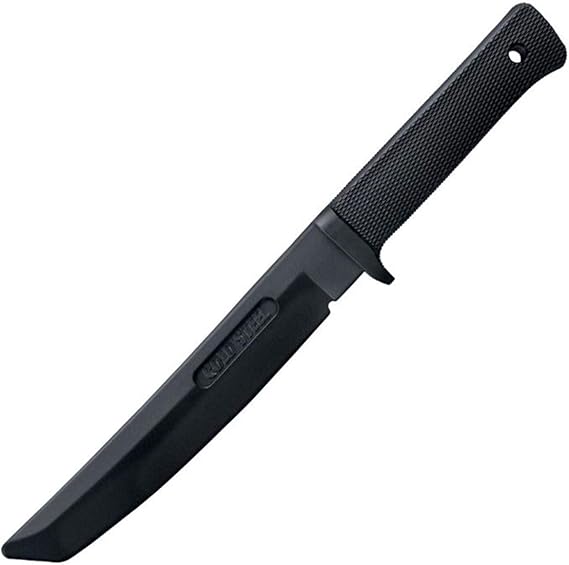
But we can do better than that affordably here in the USA. Basically what you are going to need is two hard-rubber sparring-knives, two pairs of cheap street-hockey gloves, and two sets of safety goggles. First the most popular hard-rubber safety-knife in these parts is a Cold Steel brand "Rubber Tanto" that hurt a little when you get hit with them, but not nearly as bad as if you had been hit by a wood or steel trainer instead:
Those usually go for around $10 each, so two will cost you $20.
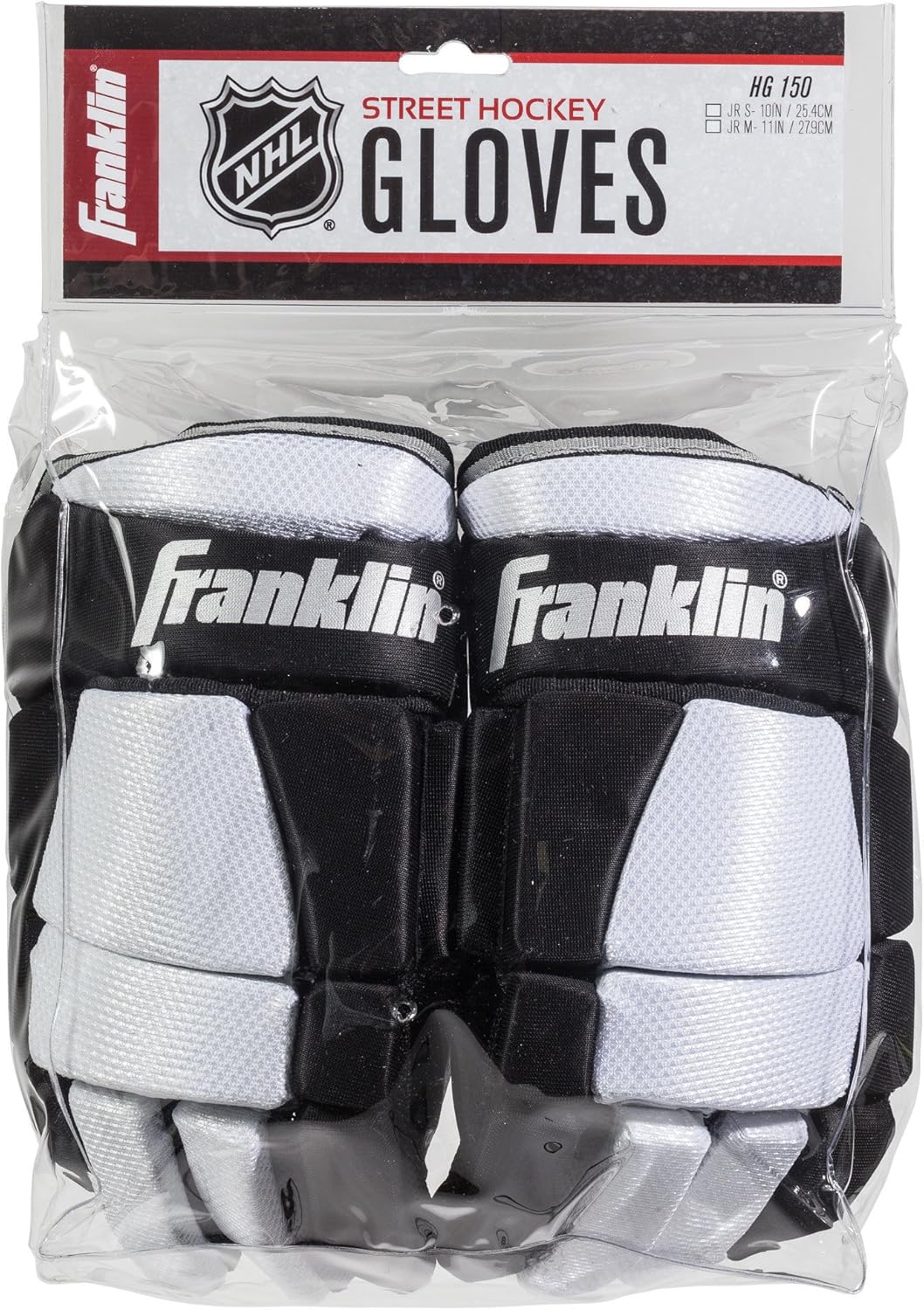
The primary target in a knife duel is the other person's hands. If you nail their weapon hand, they may drop their blade, they may loose their will to fight once injured, their dripping blood starts leaving DNA evidence that reveals their identity and their hand becomes slippery making it harder to use that hand to fight with. So of course when knife sparring it's important to do hand targeting, so the most important protective equipment is for the hands. What seems to work best for most people around here are cheap street hokey gloves:
You can get a really cheap pair for around $25 each, x2 = $50.
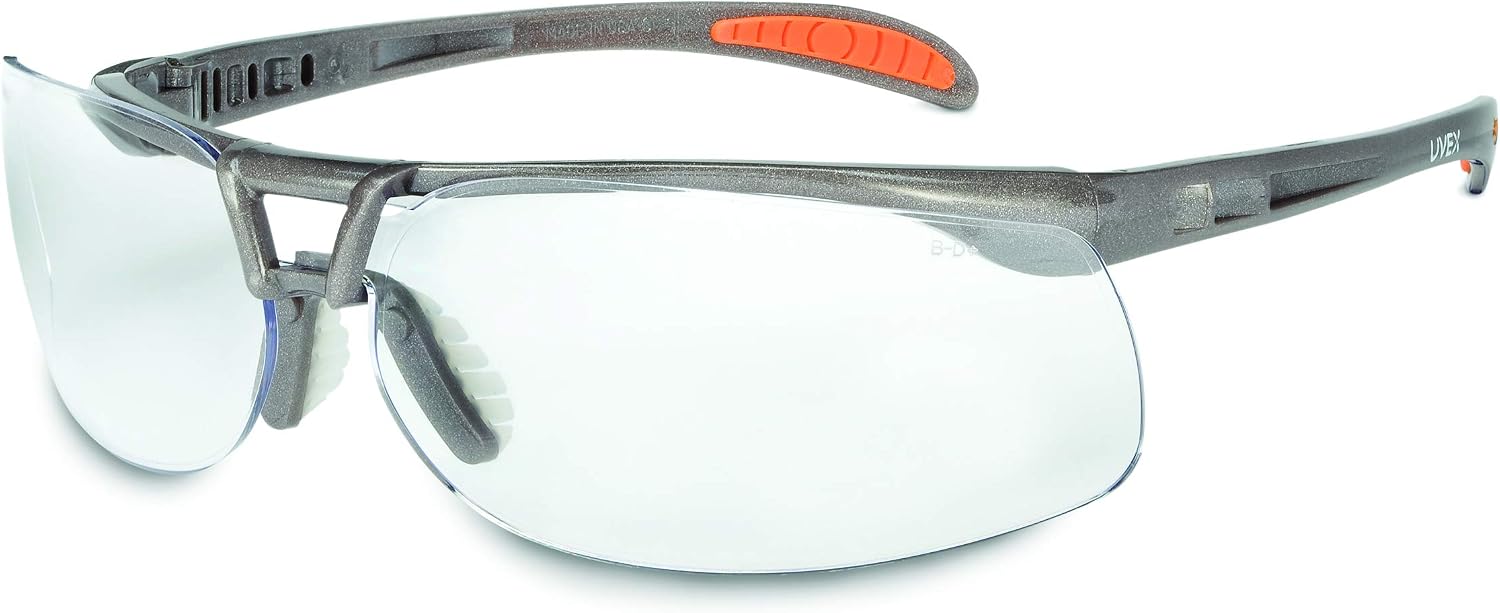
Now from here you are going to have to decide between going cheap or going for head shots. If you are going for head shots, you are going to need two lower end fencing masks, which you can usually find for about $70 each if you can look around. But we are talking cheap here, so we are going to NOT spar with face shots, and instead only get safety goggles. (No, it is NOT safe to spar without safety goggles even if you are forbidding face shots. Accidents happen - a lot - and you will poke someone's eye out if your are not careful):
You can usually get two pairs of safety goggles for under $15. So the total price of this kit would be $85 + tax, or under $100 anyways ($15 +$50 +$20.)
The next step will be to start sparring. It is OK to go light, especially at first as you get used to it. If you want extra armor on your arms or torso, just layer up with whatever coats or jackets you need to until you feel comfortable getting hacked and stabbed with a piece of hard rubber at that level of protection. You can use less and less layers the better you get and the more your pain tolerance improves. Also, 99 cent mouth pieces and groin protection is not a bad idea.
It is not OK to stop-and-go, you should keep going at it continuously throughout your sparring rounds (which should be between 90 seconds and 3 minutes,) and not spend too much time talking. As far as technique goes, the main thing is most of the time your knife and your feet should be moving, and if one stops moving for any reason, the other should stay moving.
I highly recommend you record your sparring, and before the next time you get together to spar, review your last sparring and decide what you want to work on next time you spar. At Tres Espadas we are known for being a knife-first sparring club. We do knife before anything else, before stick, before dirty boxing, before sword, before spear, before anything. The most important reason for knife-first is the evasive movement knife sparring teaches. It teaches movement with both footwork and with weapon movement. As your knife sparring skills improve, you can experiment sparring with a wider range of self defense scenarios, but make sure you have adequate safety equipment when you do so:
I have recently posted on my experience with Multi-Level Marketing and my style of 3D Thinking. Here I want to apply my 3D Thinking to the extraordinarily heinous problem of Multi-Level Marketing. Check out Anti-MLM on YouTube if you want an idea of why MLMs are so foul, but in a nutshell they are an entire economic sector of scammery that destroys individual lives, corrupts government, and stunts economic growth.
It sounds like I am extremely one sided on this, but I will remind you that I was once myself an Herbalife distributor, as much as I regret it. Though MLMs are most definitely not the answer, they are not-wrong about the problems they falsely claim to correct. In the USA, most people:
Don't have enough spare time. When you are talking about developing strong family relationships, taking care of your health, getting adequate rest, etc., this rapidly becomes an unfulfilled need rather than a fantasy luxury you would like to have some day.
People aren't able to pursue their dreams with the current lifestyle they have. Keep in mind there's two general types of dreams here: a) virtuous things you want to do with your life, a "bucket list," and b) perverse things you want in your life that can not contribute to your happiness, typically luxuries to boost perceived social status.
People don't like their jobs. Either the job is too demanding and takes up too much time, or they just don't like what they do.
Investments in the future often don't work out. Be it your education or your retirement portfolio, life is what happens when you make other plans.
The problem is that MLM will make all of these problems much, much worse. The more you try to get your MLM habit to pay for itself the more time it will consume. No one dreams of being involved in a scam that helps to ruin other people's lives and damage the global community. In the long term, it is more rewarding to be employed with a job you hate or just plain unemployed than it is to be in an MLM. For well over 99% of MLM participants, MLM will in no way compensate for your lack of education or savings.
But if MLM is not wrong about those things, and only wrong about themselves being a solution, what are the solutions to those things? Let me tell you what has worked for me:
Be mindful. Your job, no matter how terrible it is, someone is paying you to do it, and therefore it is important to someone. Let's take the lowest job on the corporate latter: the Janitor. They are looked down upon, and have to do unpleasant work for low pay. But think about it like this: there is a war going on between animals and germs. In the case of Humans, we are easily destroyed by various microbe threats. At the time of this writing we are in the midst of a COVID-19 pandemic causing serious economic damage and taking thousands upon thousands of lives. From our perspective today, janitors battle on the front line of human survival. Being a janitor IS WORTHWHILE.
Be frugal. Stop thinking of your income as a check that comes in the mail that you reuse each month. Instead see each and every penny that comes into your possession as an opportunity you will never have again, once you spend that penny it is gone for ever. Pinch pennies until they bleed and live off of that penny blood like some kind of coin vampire. The less you spend, the less money you need: this is the true path to financial independence. You can be sure that most rich people who were born poor will tell you pretty much this same thing. On good terms with your parents? Great, live in their basement. Picking a college? Pick a community college. Once you truly embrace this mindset you might be surprised how easy it is to own your "dream car."
Stop trying to buy happiness. Sometimes needs are needs and you will be miserable without something. Sometimes wants within reason are good. But happiness can not be purchased. No amount of money you will ever spend will bring you permanent bliss. No mansion on the beach, no collection of luxury cars, no harem of supermodels, no mountain of cocaine is ever going to do it for you in the long run. From personal experience I can tell you MLM won't get you there. I can also say you shouldn't embrace a diet of fast food and microwave burritos in the name of your career, spending more and more time at the office until you actually end up sleeping for a few hours a night in the emergency shelter down the hall: It's not good for you, your career, your happiness, your health, your family, your life and in the long term it's not even good for the people asking you to put in those kind of hours.
Be interested in things, and get good at some of the stuff you are interested in. You should probably pursue some form of formal education in a trade or in school. You may or may not be able to find a job you like. In my experience, any job you get, weather or not you wanted it in the first place and no matter how great it is, still becomes a chore sooner or later. Satisfaction from employment has something to do with being as good as you can reasonably be at whatever it is you do to support yourself. It is also satisfying to grow and become competent in things you do for hobbies and for entertainment. If you are going to be a janitor, at be a very good janitor that knows what you are talking about in casual conversation.
Focus on what is important to you. Ultimately large piles of green paper are not the most important thing in anyone's life. What actually IS important to YOU? Don't miss out on THAT. Take care of business: do you need mental health treatment? Get mental health treatment. Do you feel like you need to connect with a higher power? Get to it. Do you feel like you need to relive yourself of the shackles of the world view you were raised with it? Those shackles aren't going to loosen themselves. Want to have a family? I am pretty sure you know how that works. Want to be part of a family? Develop the people skills that make that possible.
Don't wait for retirement: later = never; follow your dreams NOW! As a martial artist, I can't tell you how many times I have seen this end badly; to be an effective martial artist, you have to develop at least some of your skill before retirement age! Let's say you dream of walking the beach in Hawaii in your swim suit. You are going to wait until you are 65 to do that? No one wants to see that, do everyone a favor and find another way. Find a more affordable beach to visit, or save up your lunch money for a trip to Hawaii decades before you retire, or find a job in Hawaii. If your dream is to walk the beach in Hawaii, waiting for retirement is just a way for that to never happen. That said, pick your dreams wisely, pursuing perverse dreams to try to show your neighbors you are as good as or better than them, that stuff ends badly, most belief systems advise against that kind of behavior for good reason, that entire mindset is a great way to be miserable for the rest of your life.
The easiest get-rich-scheme I know of is to work part time. When people retire, either their health is so shot they struggle to take care of themselves, or they get bored and look for some new part time vocation. You know what that means, right? Think about it: they could have just worked part time all along! This is pretty hard to do on minimum wage, but that is part of why you should pursue some form of education, so that you can get into a vocation that has a sustainable enough wage that you can make enough money to fulfill your needs and pursue your dreams on part-time wages. Nursing, accounting, and dental hygienist positions have all been known to have part-time decent-wage positions.
The biggest pet peeve I have is Multi-Level Marketing, also known as Network Marketing by it's proponents and as pyramid schemes by its detractors. The official verbiage of the CDC is to say these organizations "fit the description of a pyramid scheme," before the underfunded CDC slowly shuts them down for being pyramid schemes one by one. There is an urban legend that says there are MLM sales opportunities out there that are not pyramid schemes, but it turns out that those sales jobs also resemble pyramid schemes.
As an adolescent my neighborhood was rocked by two separate tragedies. In two different years, friends of mine's fathers committed suicide. In both cases, these men were having career struggles and decided to put a lot of their time, money and effort into multi-level marketing "opportunities," one of them being Amway. No one else in the neighborhood was as involved in MLMs, and no one else in the neighborhood died that way in those years, leaving our entire neighborhood highly skeptical of MLMs, especially Amway.
When I graduated from high school in 1993 I decided to check out "turn key mail order business." This led me to two highly questionable practices, first Herbalife and then later an actual mail order scam. When I called up the number in the Little Nickel for the first turn-key mail-order business, it turned into an Herbalife recruitment very quickly.
Already skeptical of Amway, I took the Herbalife business claims at face value and decided to give it a try, with the caveat that if I couldn't make money off of sales myself, I wouldn't recruit anyone into my downline. As trained by my upline, I printed out thousands of leaflets and with the help of friends and family canvased the windshields of the parking lots in my county with these "lose weight now, ask me how" leaflets. The calls started coming in, and using the script from my upline, I sold people "Cellular Nutrition" and "Thermogetics" dietary supplement kits.
I had return customers, and had a clientele of a few dozen people all together. At first people were very impressed with the product (I myself enjoyed the "cellular nutrition" as well.) I had numerous friends approach me, saying that they had heard about how successful I had been, and how they wanted to get into my downline. I put them on a waiting list to get into my downline, and explained to them I wasn't sure how legit Herbalife actually was, and that if I could get it to work for me, I would recruit them right away*.
Then the business collapsed. The biggest problem was that after about three months, return customers started complaining that the supplements did not come with the amount suggested in the sales pitch I used from my Herbalife upline. The most glaring example is one of the three products in the Cellular Nutrition kit was a protein shake. I was trained to sell one canister as a one month's supply. This shake was to replace meals 1 or 2 times per day. But the shake canisters only contained 20 servings!
I had to go back to the drawing board and redesign my product offerings. But the problem was NONE of the products aligned up correctly for any sort of resale. The other parts of the Cellular Nutrition kit came in strange, nonsensical amounts as well. The Theromogetics came in two separate pills that had to be taken together, but the amount in the two separate bottles couldn't match up in anyway that made sense. The best case scenario was that Herabalife hadn't seriously thought this product line through for the end seller, which implied the worst case scenario, that Herbalife never intended to make money through the sale of their products outside of their downline in the first place!
Intentional or not, Herbalife did indeed seem to be a pyramid scheme, where recruitment was king and no products were designed to be sold outside of people suckered into joining Herbalife. With all my customers gone and my reputation tarnished, my Herbalife up line disowned me, with two disturbing statements:
"The real money is in recruiting in your downline. You aren't doing that, so this is not going to work out for you."
"I known you are Mormon, and I know Amway is a big Mormon thing. I can see why you want to recruit your friends into Amway instead of Herbalife, Herbalife isn't as big."
Apparently he didn't hear me when I told him I would never do Amway, or maybe he assumed I was as sleazy and two faced as he was. What is strange though is how he considered Amway to be legitimate. I was done.
So I decided to give the Turn Key Mail Order Business one more try. I sent off an SASE to a PO Box as advertised in the Little Nickel. The response (which looked like something from the 1950's) stated "If you send me $10, I will send you everything you need to start your own Turn Key Mail Order Business, and you will never have to send me any money again afterwords, nor will there be any more required training."
I sent in the $10, full well realizing it was some kind of scam, but wanting to know more about how the scam worked. What I got back read "The last letter I sent you, and this letter as well, are the business that I promised you. All you need to do is take out space in the want ads like I did and do the same thing, and you will have people sending you $10 in the mail, just like me." This simple mail order scam helped me understand exactly what Herbalife and other MLMs are: an "endless chain" scam. Endless chain scams ignore the whole concept of market saturation, assuming an infinite population to profit from. Endless chain scams include all Ponzi and Pyramid type schemes in general, especially MLMs.
By the late 90's I was serving a mission for The Church of Jesus Christ of Latter-day Saints (LDS) in the Western Pennsylvania area. In a small town outside of Pittsburgh, a local LDS congregation was purported to have an "apostasy" problem, and my first assignment was to that congregation, probably because I was about 4 years older than most of the other missionaries and had a year of college. At first I made the same observation the other missionaries had made, which is that there was a very large number of congregation members who wore USA-flag ties, every Sunday, and that they regarded themselves as a special group within the congregation. They called themselves "Constitutionalists," and had libertarian political views - including the idea that one should avoid paying taxes, which is antithetical to LDS teachings, and indeed a point of apostasy. There was associated apostate phenomenon, such as unauthorized meetings of Constitionalists in the Chapel after official Church services.
Then while having lunch with one of the Constitutionalists, she started using "residual income" language that was very familiar to me. I clammed up, not saying anything, and listened carefully. Afterwords I told my companion "she's the problem right there. She's doing a multi-level marketing scheme, and the product they are using is far-right literature. She is the center of it, the rest of these people are in her MLM downline." He scoffed at my suggestion, doubting that something as insignificant as an MLM could be leading to the potential excommunication of half of a congregation. But a year later that same companion, who had become one of the highest ranking missionaries in the mission, found an excuse to come visit me: I had been 100% correct on my analysis, and another talented missionary had found it necessary to root out the problem.
Going to college in the mid 2000's I began to realize how politically potent MLMs had become. They had significantly corrupted the GOP (by way of Amway) and had a strong influence even over the Clinton administration (by way of Herbalife.) I was doing an internship for school with Indymedia when they participated in and helped organize some of the biggest anti-war protests in history, and I started to realize that there was a fine line between the political corruption caused by organized criminal enterprise of Amway (and other MLMs) and the corruption caused by the military industrial complex, especially through the Devos family:
The Bush Dynasty was in no small part funded by Amway, and the Bushes had actually been involved in selling Amway to their pyramid scheme victims:
But George W. Bush with his total disregard for truth was even far more involved than his father, choosing a vice president with strong Blackwater connections and selling as much Amway to pyramid scheme victims as he could get away with, a practice he continues today:
But the Democratic Party was not innocent of MLM influence either. Madeleine Albright, Clinton's treasury secretary, was a huckster for Herbalife:
(And later Hillary's campaign in 2016 was rumored to have legal services provided by the Herbalife lawyer farm.)
After finishing grad school and paying off my student loans, I became more involved in Social Media because of other projects I was working on. There I noticed that companies that used to be into direct sales but may have not been MLMs per say (such as Avon and Tupperware) now seemed to have been corrupted by the likes of Amway and Herbalife, and were now full blown pyramid schemes. And now there were hundreds of new MLMs, the most problematic one being ACN promoted by infamous scoundrel Donald Trump.
Some of my LDS friends were involved in ACN, and I remembered a missionary on my mission that was trying to get other missionaries to join the Maelaleuca MLM. I had also learned over the years that Utah, headquarters of the LDS, is also the largest epicenter of the scourge that is MLM. I started to realize that the MLM I had helped to chase out of the LDS in Pennsylvania, (which profited by scamming people into trying to sell the gospel of the Cleon Skousen,) probably had Utah roots and had come to Pennsylvania through LDS subculture. I became alarmed: is LDS necessarily tied to MLM? Is LDS proselyting a real economic threat to a community because of the damage MLM can do?
Concerned about these problems, in January 2013 I started a facebook group called "Mormons Against Multi-Level Marketing." (This group is now called "Stop MLM Schemes.") LDS leadership is concerned about any form of "affinity fraud," and the LDS leadership has always strongly cautioned against any and all "Get Rich Quick Schemes." I have come to realize that these schemes include fake business gurus, "legit" MLM direct sales (which turn out to also behave like pyramid schemes,) actual Ponzi schemes, fake colleges providing no real training like Trump University, and a hundred other things LDS members could be suckers for, including of course classic MLMs like Amway, Herbalife and ACN. LDS from the beginning have felt humans should strive to be more like God, and get rich quick schemes prevent people from spending their time developing valuable skill sets, and getting good at stuff is a big part of being LDS*.
Starting in 2013 some of the people who joined Mormons Against Multilevel Marketing were not Mormon, saying they could find no other Facebook groups that were truly anti-MLM. Not very many people understood just how bad MLM was and what kind of economic hazard it represented to our society. The MLM "industry" makes around the same amount of money as Hollywood, but instead of providing good jobs and entertaining everyone, the MLM industry just sucks the money out of would be entrepreneurs* and funnels it up into the hands of pyramid scheming miscreants; The MLM industry stunts the growth of our local, national and global economies*. When I spoke of MLM, most people accused me as having a political agenda, or they wrote me off as a conspiracy theorist.
I was shocked when I realized Donald Trump was going to be the GOP candidate in 2016. How could the party of fiscal responsibility be so financially illiterate? Beyond promoting ACN even on The Apprentice, he had sought out another MLM afterwords and promoted it, this time using his own name: the Trump Network. I had the same reaction to the Trump nomination as Mitt Romney.
The media finally took note of MLM as a problem as they looked into Trump's background as he ran for president. It was the first time I had seen any major attention to what I considered one of the world's most serious problems since the 90's. Recently I discovered within the last few years an Anti-MLM movement has started to gain momentum. It is largely led by women on YouTube, and they are producing very informative and entertaining content.
*Going forward I think it is important to look for honest alternatives to MLM. Many people in MLM could be doing legitimate small businesses instead. Part of why I was able to get so many return customers was because I had far less market saturation in my community than if I had recruited several other people into my downline to try to sell Herbalife products in that same area. In fact it was the bad packaging practices of Herbalife itself that led directly to the collapse of my business.
In today's world if you really want to help people get in shape, you should get certified as a personal trainer. Any supplements you incorporate into that practice should be purchased in bulk so you can get them at a discount in order to resell to your fitness customers. You will not find MLM to be helpful in this regard, because their products are overpriced, quality is often questionable, and I personally found the branding/packaging to be designed to reassure pyramid scheme victims rather than to work for fitness customers. The truth is that like most MLM victims my heart really wasn't into fitness, but if it was, here is the small business approach I should have taken: